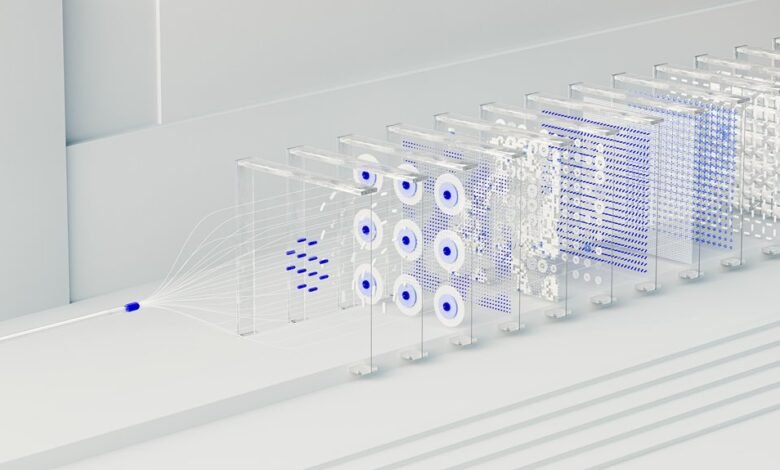
Neural Beam 965023624 Stellar Flow represents a significant advancement in the realm of astrophysical data processing. By employing sophisticated neural networking techniques, it effectively manages and interprets complex datasets. This innovation enhances exoplanet detection and deepens the understanding of cosmic phenomena. As researchers explore its capabilities, potential applications in astrophysics emerge. The implications of this technology could reshape the landscape of astronomical research, provoking curiosity about its future trajectory.
Understanding Neural Networking Techniques
Neural networking techniques form the backbone of many modern artificial intelligence applications, enabling machines to recognize patterns and make informed decisions.
Various neural architectures, such as convolutional and recurrent networks, are employed to address specific tasks. These architectures rely on diverse training methods, including supervised and unsupervised learning, to optimize performance and enhance the machines’ ability to adapt to complex datasets and evolving environments.


Stellar Data Processing Capabilities
While traditional data processing methods have their limitations, advanced systems like Stellar Flow leverage cutting-edge algorithms to enhance data analysis and interpretation.
This platform exemplifies stellar data analysis capabilities through robust machine learning integration, enabling the extraction of meaningful insights from complex datasets.
Potential Applications in Astrophysics
The advanced data processing capabilities of Stellar Flow facilitate numerous applications in the field of astrophysics.
Notably, it enhances exoplanet detection through sophisticated analysis of light curves, enabling the identification of planetary transits.
Additionally, Stellar Flow can analyze cosmic microwave background radiation, improving our understanding of cosmic evolution and structure formation, thereby contributing significantly to theoretical models and observational astronomy.
The Future of Machine Learning and Astronomy
Advancements in machine learning are poised to revolutionize the landscape of astronomy, offering unprecedented capabilities for data analysis and interpretation.
Enhanced data visualization techniques will enable astronomers to discern complex patterns within vast datasets.
Additionally, predictive modeling will facilitate the forecasting of astronomical events, allowing scientists to explore uncharted territories.
This integration empowers researchers to push the boundaries of knowledge and understanding in the cosmos.
Conclusion
As the capabilities of Neural Beam 965023624 Stellar Flow continue to evolve, researchers stand on the brink of unprecedented astronomical revelations. This synergy of neural networking and astrophysical data processing not only enhances exoplanet detection but also deepens our comprehension of the cosmos. Yet, as new insights emerge, one wonders: what hidden secrets of the universe lie just beyond the horizon, waiting for the next breakthrough in machine learning? The quest for knowledge has only just begun.